

Why High-Net-Worth Individuals Should Demand Nothing Less Than Perfection
For high-net-worth individuals (HNWIs) and serious collectors, a diamond is far more than a glittering ornament; it is a portable store of wealth, an irreplaceable piece of natural artistry, and a powerful legacy asset. While the “4 Cs”, Carat, Color, Clarity, and Cut, are the standard metrics, it is the Cut that holds the ultimate key to a diamond’s beauty, scarcity, and long-term value.
Unlike the other Cs, which are dictated by nature, the cut is a product of human artistry and precision. It’s the factor that transforms a rough stone into a breathtaking spectacle of light. For those operating at the pinnacle of the market, understanding the nuances of the cut is paramount. This isn’t about mere preference; it’s about maximizing optical performance and guaranteeing rarity.
The Unseen Difference: Cut Quality as a Value Driver
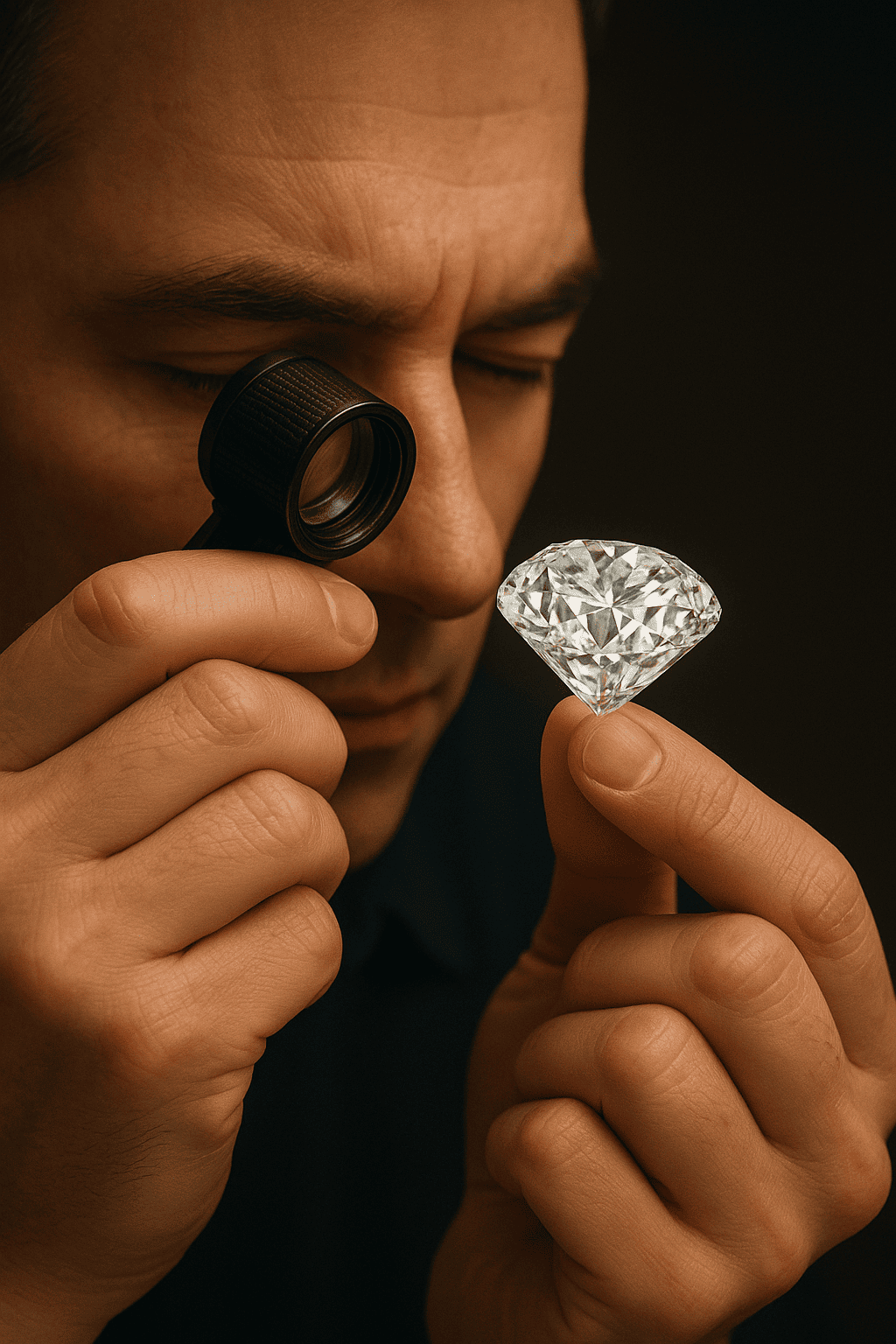
When assessing a high-value diamond, the difference between an ‘Excellent’ and a truly ‘Ideal’ or ‘Super Ideal’ cut is often invisible to the untrained eye, yet it translates into a dramatic difference in brilliance, fire, and price. For an investment-grade diamond, an exceptional cut is non-negotiable, it’s the primary way a stone distinguishes itself from the wider market.
Why Cut Commands the Premium
Light Performance: The cut determines how effectively a diamond handles light. A masterfully cut stone acts like a perfect prism, optimizing three key optical effects:
Brilliance (Brightness): The total white light reflected from the diamond’s interior and exterior facets.
Fire (Dispersion): The scattering of white light into the colors of the rainbow.
Scintillation: The flashes of light and dark, or the “sparkle,” produced when the diamond is moved.
Weight Retention vs. Beauty: A diamond cutter must choose between sacrificing rough diamond weight to achieve the perfect proportions or retaining weight for a higher carat number. For an Ideal cut, the cutter prioritizes light performance over carat weight. This scarcity, the courage to forgo a larger stone for a perfect one, is what drives the price premium and rarity for HNWIs.
Rarity and Craftsmanship: Only a tiny fraction of all diamonds (often less than 1%) achieve the top-tier cut grades like AGS’s Ideal-0 or a GIA Triple Excellent that falls within the narrowest, most perfect proportion parameters (sometimes referred to as Super Ideal). This level of craftsmanship, requiring immense skill and time, fundamentally limits supply.
Deciphering the Diamond Grading Landscape
For the astute investor, navigating the cut grading system requires looking beyond the single-word grade on a certification. Different labs use different scales, which can be a source of confusion and an area for strategic assessment.
Grading Body
Top Cut Grade
What it Represents
GIA (Gemological Institute of America)
Excellent
The highest grade on their 5-point scale. It signifies very high light return, polish, and symmetry.
AGS (American Gem Society)
Ideal (0)
The highest grade on their 11-point scale (0-10). It is often considered a more stringent standard, assessing light performance via proprietary tools like the ASET (Angular Spectrum Evaluation Tool).
Export to Sheets
The Importance of Optical Precision
While a GIA Excellent is a fine stone, those seeking the pinnacle of rarity often look for Hearts and Arrows (H&A) patterns, which are a visual manifestation of perfect optical symmetry and precision.
Hearts and Arrows: When viewed through a special scope, these diamonds display eight identical ‘hearts’ from the pavilion (bottom) and eight perfect ‘arrows’ from the crown (top). This pattern proves that all facets are aligned with microscopic precision, resulting in maximum, evenly distributed brilliance. Many of the finest Super Ideal cuts exhibit this feature.
Key Insight for HNWIs: When evaluating a GIA Excellent or AGS Ideal diamond, insist on seeing ASET or Idealscope images. These proprietary tools reveal exactly where a diamond is collecting and reflecting light versus where it is ‘leaking’ light. For multi-million-dollar stones, this evidence removes all ambiguity about true optical performance.
Cut in Action: Beyond the Round Brilliant
While the Round Brilliant is the gold standard for cut grading (accounting for the vast majority of Ideal/Excellent grades), sophisticated buyers are increasingly drawn to Fancy Shapes for uniqueness and contemporary appeal.
Shape
Cut Priority
Investment Note
Round Brilliant
Maximize Brilliance, Fire, Scintillation.
The Safest Bet: Most scientifically optimized cut for light return; holds value most reliably.
Emerald & Asscher
Maximize Clarity and Symmetry.
The Hall of Mirrors: Not about sparkle, but about the elegant ‘steps’ of light/dark created by the step-cut facets (Clarity is critical here, as inclusions are more visible).
Oval, Pear, Marquise
Maximize Length-to-Width Ratio and Symmetry.
Focus on Proportion: Must be cut to avoid a “bow-tie effect” (a dark area across the center where light is lost). A well-cut fancy shape will look larger per carat.
Cushion
Maximize Fire and Vintage Appeal.
The Modern Hybrid: Cut quality vastly differs between chunky (antique look) and crushed ice (modern sparkle) faceting patterns. Demand a cut that optimizes the desired aesthetic.
Export to Sheets
A Final Word on the Art of Investment
In the realm of high-value assets, the cut of a diamond is the single largest variable factor influencing its aesthetic perfection and long-term collectability. Carat size may draw attention, but the cut is what holds it.
For the HNWI, purchasing a diamond with a Super Ideal cut is not an extravagance; it is a fundamental choice to acquire an asset of proven, certified rarity and unparalleled optical beauty. It ensures that the piece you own will not merely retain its value but will appreciate as a testament to the pinnacle of diamond artistry.
To navigate this elite segment, always partner with a diamond curator or gemologist who provides transparent grading, offers advanced light performance data (ASET/Idealscope), and understands that for you, perfection is the only acceptable standard.
it dolor. Urna molestie at elementum eu facilisis sed odio. Vestibulum lectus mauris ultrices eros in. Venenatis cras sed felis eget velit aliquet sagittis. Nunc lobortis mattis aliquam faucibus.

Tortor posuere ac ut consequat semper viverra nam libero. Proin libero nunc consequat interdum varius sit amet mattis. Sed faucibus turpis in eu mi bibendum neque egestas. Phasellus egestas tellus rutrum tellus pellentesque eu tincidunt. Eu augue ut lectus arcu bibendum at varius. Nunc vel risus commodo viverra maecenas accumsan lacus.
Auctor augue mauris augue neque. Euismod nisi porta lorem mollis aliquam ut porttitor leo. Id leo in vitae turpis massa sed elementum. Sollicitudin nibh sit amet commodo nulla facilisi nullam vehicula. Enim diam vulputate ut pharetra sit amet aliquam. Ipsum dolor sit amet consectetur adipis
Tortor posuere ac ut consequat semper viverra nam libero. Proin libero nunc consequat interdum varius sit amet mattis. Sed faucibus turpis in eu mi bibendum neque egestas. Phasellus egestas tellus rutrum tellus pellentesque eu tincidunt. Eu augue ut lectus arcu bibendum at varius. Nunc vel risus commodo viverra maecenas accumsan lacus.